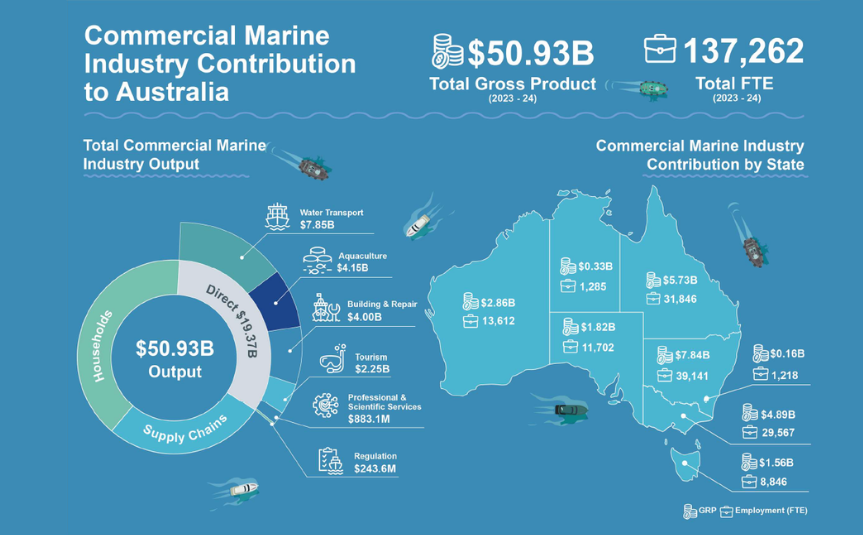
The Australian Commercial Marine Group (ACMG) today released the Australian Commercial Marine Economic Impact Statement (EIS), revealing the sector supports 137,262 jobs nationally and contributes $25.16 billion to the Australian economy each year, with $50.93 billion in total industry business output.
Commissioned by ACMG and prepared by independent economic consultants AEC Group, the report provides the most comprehensive assessment to date of the Australian commercial marine sector. It measures the industry’s direct, supply chain and broader economic impacts, including employment, wages and industry activity across tourism, logistics, manufacturing and trade.
The EIS is a critical benchmark for industry growth, with ACMG CEO David Good asserting that the study marks a pivotal step in strengthening the industry’s voice and ensuring its value is recognised in national decision making. David commented: “This study provides hard evidence of the economic significance of Australia’s commercial marine sector. For the first time, we have a robust, independent benchmark that captures the full scale of the industry’s contribution to jobs, productivity and national prosperity. The EIS will help guide policy, investment and long-term growth.”
The EIS defines the commercial marine sector with clarity, ensuring the report accurately reflects the true commercial marine footprint. It covers passenger vessels, event and function boats, workboats, deep sea charter fishing vessels and tourist boats, and excludes vessels used primarily for leisure such as houseboats, as well as defence, cargo, freight and cruise ships.
The study found the Australian commercial marine industry generates:
- $50.93 billion in annual business output
- $25.16 billion in Gross Product contribution to the Australian economy
- 137,262 full time equivalent jobs supported nationwide
- $14.2 billion in wages paid to Australian households each year
The findings provide a strong evidence base to support government policy, infrastructure investment and workforce development across Australia’s marine industry. The report also highlights the importance of the sector’s supply chains, which extend across transport, tourism, advanced manufacturing, engineering and marine science.
Of note, the study highlighted New South Wales as the largest economic driver followed closely by Queensland. However, with the opportunities to be presented by the upcoming Olympic Games, Queensland is expected to surpass NSW if the comprehensive 2032 Marine Project currently residing with government is adopted.
ACMG is presenting the full findings today at the ACMG Great Barrier Reef Conference in Cairns, where operators, suppliers and sector partners have gathered to discuss the study’s implications for the future development of Australia’s commercial marine industry.
The Australian Commercial Marine Economic Impact Statement is available to ACMG members and stakeholders via the Australian Commercial Marine Group.